If you've spent time in health groups, forums, and reviews looking into magnesium glycinate for sleep, you've probably run into reports like these:
"Magnesium glycinate keeps me up all night. I wake up every 15 minutes."
"My 3 a.m. wake-ups were caused by glycinate. I stopped three nights ago and I've slept better since."
"Two nights it was magic. Third night my system flipped on me."
"I doubled from 200mg to 400mg because I thought it wasn't working. Worst night of my life."
"It went from holy grail to sleep disruptor."
"I lie there with my heart going, more awake than before I took it."
"I really wish magnesium worked for me."
If one of those stopped you — it isn't bad luck, and it isn't you doing it wrong. There's a reason. It's specific. And once you see it, you'll never read a supplement label the same way again.
Everyone Who Recommended It Was Right. That's What Makes This Worse.
Magnesium does belong in the sleep conversation. It helps hold the balance between the nervous system's excitatory and calming signals, and it plays a role in your body's own melatonin production. Glycinate genuinely is the right form: it absorbs at roughly 24–30% (oxide, the one on every drugstore shelf, absorbs around 4%), and it doesn't wreck your stomach.
So the advice wasn't wrong. Which is exactly why it's so disorienting to follow it and end up worse.
You did everything right. You bought the recommended form. You took it at the recommended time. And something in you responded in the opposite direction.
One Missing Ingredient Decides If Magnesium Calms You — or Wakes You Up
Magnesium glycinate is two things bound together: magnesium, and glycine. Glycine is the part that helps you sleep — it's calming, it lowers your body temperature, and it carries the magnesium where it needs to go.
But glycine has a second job almost nobody mentions. It's not only a brake. It's also the key that lets your brain's excitatory signals fire. Without glycine present, those signals can't switch on at all.
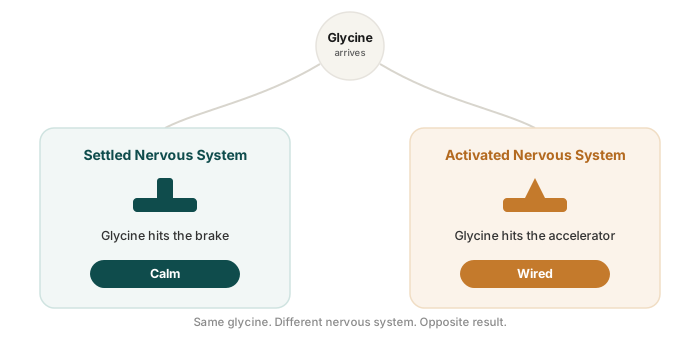
The practical translation: glycine isn't a sedative. It's a permission slip. And what it gives permission to depends entirely on the state of the system it walks into.
- Arrive in a nervous system that's already settled, and glycine hits the brake.
- Arrive in one that's been running hot for months — stress that never fully switched off, cortisol still elevated at midnight, a mind that has forgotten how to power down — and that same glycine can hit the accelerator instead.
Same capsule. Same dose. Same brand. Opposite result. Not the wrong magnesium. Magnesium arriving alone.
Why the Third Night Is Always the One That Turns
Two details give this away, and you may have lived both.
1. You took more, and it got dramatically worse.
Under normal supplement logic that makes no sense — if a little does nothing, more should do something. But this effect runs in two directions depending on how much glycine is in play. A lower amount leans toward calm. Push it higher and you start feeding the excitatory side instead. Doubling the dose wasn't a bigger push in the right direction. It was a push into the wrong one.
2. It worked beautifully, then stopped.
That's not tolerance, the way it happens with a sleeping pill. It's glycine accumulating in a system that was already tilted. The first nights land on one side of the line. Then they stop landing there.
To be straight with you: this reaction isn't common, and it's poorly documented in clinical trials, where magnesium usually improves sleep — which is exactly why nobody warns you about it, and why you assumed the problem was you.
Now Comes the Part Nobody Ever Told You
If you've used magnesium glycinate — or you're about to — you're on exactly the right track. But you need to be careful here, because you'll only get the deep, restful nights you're after if you use magnesium glycinate the right way.
And here's what the right way means: for the glycinate to work properly, you have to calm the brain first. Then the glycinate can do its job.
After going through the research, we found only two ways to get there.
Way One: The Plate (The Food Protocol)
The first one works. It consists of putting the right foods on your plate — the ones carrying the same compounds that settle a nervous system before the magnesium arrives:
- Magnesium — spinach, chard, pumpkin seeds, almonds, black beans
- Glycine — bone broth, gelatin, the connective tissue most people trim off and throw away
- L-theanine — green tea leaves, and essentially nowhere else
- GABA — fermented foods: kimchi, miso, tempeh, sprouted brown rice
- Apigenin — chamomile, parsley, celery
- Lemon balm — the fresh herb, brewed
- Tryptophan (the 5-HTP pathway) — eggs, turkey, cheese, pumpkin seeds again
- Vitamin B6 — salmon, chickpeas, potatoes
- Melatonin — tart cherries, pistachios, oats




But this path is close to impossible in practice. The magnesium in food comes from the soil it grew in, and farm soil has been losing magnesium for decades — on top of the agricultural chemicals that strip out a good part of the nutrients along the way. The ground that's still genuinely rich in magnesium is volcanic soil, and that is not where most of the food on your plate was grown.
So the path works. It just demands a great deal of discipline, real nutritional knowledge, and a nutritionist following you along the way.
Way Two: The Right Dose, Already Assembled
Now, the second way fits like a glove into anyone's routine. It's simple, and it's accessible.
This solution is so powerful because it calms your nervous system through the perfect combination of GABA, L-theanine, apigenin and lemon balm — so the magnesium can step in and let you sleep deeply through the night.
That powerful solution is called Sonnus.
Sonnus has been the standout of 2026 against sleepless nights, because it has pure ingredients, a clean-label formula with seven-stage purity testing per batch, and the exact amounts that let you fall asleep — and wake up the next day with energy, through restorative sleep.
Ten sleep-support ingredients in bioactive forms: magnesium bisglycinate, L-theanine, GABA, apigenin, lemon balm, 5-HTP, bioactive B vitamins, and a precise 0.9mg of melatonin — a signal, not sedation. Two gummies, 30 minutes before bed. That's the protocol.
Now the choice is yours. The more time passes, the more bad nights come — and the deeper that pattern sets into your nervous system, the harder it gets to turn it around.
Click the link below and get to know Sonnus.
What People Ask Before They Switch
How much should I take?
Clinical guidance for adults clusters around 250–500mg of elemental magnesium at bedtime. Elemental is the number that matters — a "1,000mg" glycinate capsule contains far less actual magnesium than that. Most single-ingredient capsules bury this on the back of the label, which is how people end up accidentally taking double what they think. Sonnus is dosed as a fixed two-gummy serving, so there's no math to get wrong.
Glycinate or bisglycinate — is there a difference?
Functionally, no. Bisglycinate is just the precise term: two glycine molecules bound to one magnesium atom. What matters more is what the label doesn't say — some products blend in cheaper oxide and only disclose the total magnesium. Sonnus uses bisglycinate as the stated form, with purity testing at seven stages per batch.
How long until I notice anything?
Most reports land between a few days and two to three weeks. This isn't a sedative, so the first night isn't the test. Where high-dose melatonin gummies create a false sense of progress — you fall asleep fast, then wake groggy and dependent on the dose — Sonnus uses 0.9mg as a signal rather than a knockout, so what you're feeling by week two is your own sleep, not the supplement holding you down.
I already had a bad reaction to magnesium glycinate. Why would this be different?
Honest answer: it depends on why it happened. If unbuffered glycine was the issue, that's the specific variable a formula with calming cofactors addresses — the glycine isn't arriving alone anymore. If something else is going on, this won't fix it, and an ongoing sleep problem is worth raising with your doctor to rule out causes like sleep apnea.
Will it make me groggy in the morning?
That's usually a melatonin dose problem, not a magnesium problem. Most sleep gummies run 5–10mg of melatonin, which is many times what the body releases on its own, and the hangover is the cost. Sonnus contains 0.9mg for that reason.
Can I take it with medication?
Talk to your healthcare provider first — especially with prescription medication, pregnancy, nursing, or a diagnosed condition.
The One Line Worth Taking With You
If magnesium glycinate didn't work for you, the problem probably wasn't the magnesium, and it wasn't the dose. It was glycine showing up alone. Which means the thing to look for on a label was never a bigger milligram number. It was what else is in the bottle.